








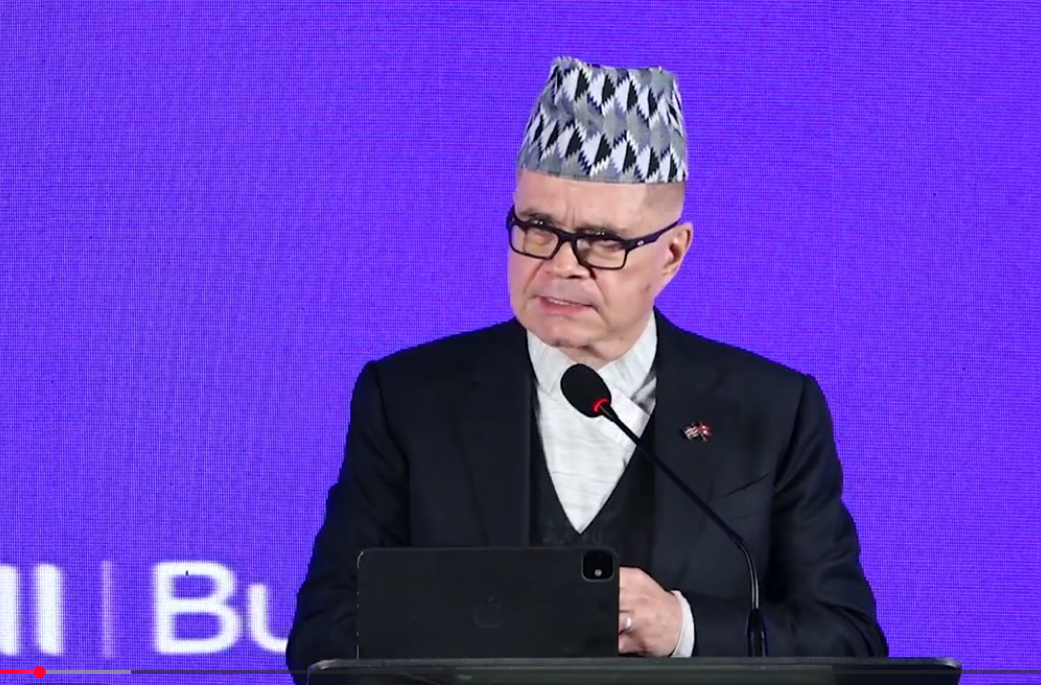


Kathmandu: Michael Foley, Chief Executive Officer of Ncell, said Nepal needs significant investment in digital infrastructure to unlock its economic potential, describing the current period as a turning point.
Speaking at a conference in Kathmandu, Foley highlighted that Nepal is currently facing a “deep technology deficit,” particularly in telecommunications networks, data centers, and advanced digital systems.
“Digital connectivity is no longer optional, it is foundational,” he said, noting that millions of users in Nepal still rely on 2G services while the global market is advancing toward 5G and even thinking about 6G technologies.



Up to $250 Million Investment Planned
Foley said Ncell is prepared to invest between $200 million and $250 million to upgrade its network and expand digital capabilities, pending regulatory approvals. The company has already applied multiple times for 5G trial spectrum and is planning to roll out a standalone 5G network.
He also revealed plans for:
- Large-scale data centers
- Expansion of fiber-to-the-home services
- Partnerships with international investors from Asia, Europe and the United States
“These are long-term investments, and we are ready to commit,” he said.
Global Attention on Nepal
Foley noted that recent political developments in Nepal have attracted growing global interest, particularly among young people and the Nepali diaspora.
Referring to a recent conference at Harvard and MIT, he said the enthusiasm among Nepali youth abroad was “palpable,” with many closely following developments in Nepal.
“People across the world are asking : what is happening in Nepal?” he said.
Private Sector Must Take Responsibility
Emphasizing the role of businesses, Foley said companies must not remain passive observers but act as “active participants” in the country’s transformation.
He stressed that the new generation demands accountability, purpose and digital excellence and businesses must evolve accordingly.
Digital Infrastructure Key to Foreign Investment
According to Foley, Nepal’s ability to attract foreign direct investment (FDI) depends heavily on building strong digital infrastructure.
“The digital economy represents a historic opportunity for Nepal to leapfrog traditional barriers,” he said, adding that global investors make highly competitive decisions based on infrastructure readiness.
Call for Collaboration and Youth Engagement
Foley underlined that economic transformation cannot be achieved by the government alone and requires collaboration between the public and private sectors.
He also urged Nepali youth studying abroad to return and contribute to the country’s growth, suggesting that even a small number of entrepreneurs could significantly boost economic expansion.
“Economic transformation is not the result of a single policy, it is the outcome of sustained collaboration,” he said.

